
Cold-weather dressing goes wrong in a predictable way: you add a layer for every degree, and by the time you leave the house the outfit is lumpy, one sleeve is bunched up under another, and the top you wanted to show has disappeared. Good layering outfits for cold weather work the other way around. Each layer has one job, and the first one, the base, is the one that decides whether the rest of the outfit sits properly.
This guide breaks a cold-weather outfit into three layers, shows which pieces from the bodysuits collection and the wider catalog fit each layer, and finishes with six combinations you can copy.
The three-layer idea, in plain terms
- Base layer: the thin, close-fitting piece against your skin. Its job is to stay put and stay smooth.
- Middle layer: a knit, hoodie or shirt that gives the outfit its character.
- Outer layer: a blazer, jacket or coat that adds shape and handles the weather.
We are only talking about styling here. A base layer in this context is a close-fitting garment under your clothes, not a technical item, and none of the pieces below makes a claim about warmth.
Choosing the base layer
Long sleeve, smooth: the do-everything base
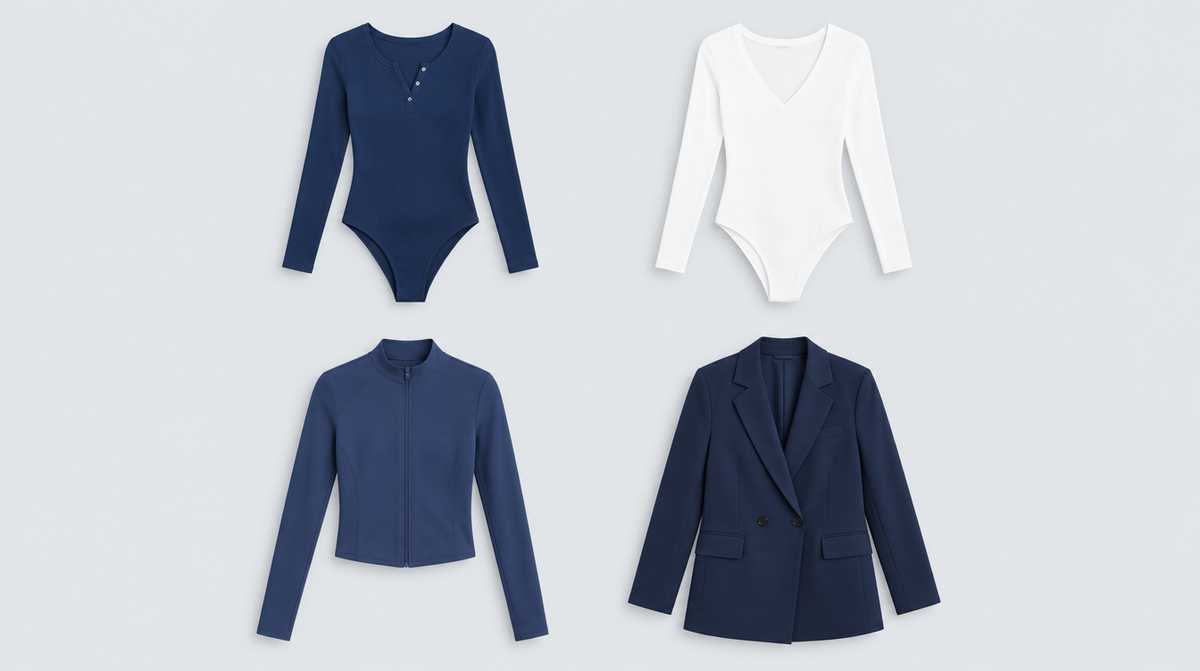
The Seamless Long Sleeve Shapewear Bodysuit – Smooth Stretch is a one-piece with structured panels across the midsection, listed in black, blue, brown and white. Because it is one piece, it does not ride up under a jacket, and the sleeves stay narrow enough to fit under knitwear.
Long sleeve, ribbed: the visible base
The Women's Seamless Ribbed Long Sleeve Bodysuit has ribbed texture, a scoop neckline and long sleeves that the listing says suit cooler days. It comes in black and white, sizes S to 2XL. Wear it on its own with a jacket, because the ribbing is worth showing.
Sleeveless high neck: the base for sleeves and sweaters
The Women's Seamless High Neck Sleeveless Bodysuit has an extended cap shoulder and a high neckline that offers light coverage. It comes in black and gray, sizes S to 2XL. It works under a shirt or knit where you want the base to disappear.
Middle and outer layers
The zip jacket: easy to open and close
The Women's Lightweight Casual Zip Jacket – Relaxed Fit has a full zip front, a high neckline and long sleeves, with a lightweight construction that the listing says suits layering. It comes in ten colors, S to XL. Over a bodysuit, you can zip up for more coverage or open it when you walk into a warm room.
The blazer: the structured layer
The Women's Double Breasted Blazer Jacket has overlapping front panels, a button front and a tailored silhouette, in navy, black, brown, gray and white, sizes XS to L. A structured jacket is the best way to turn a simple base into a finished outfit.
The hoodie: the relaxed layer
The Women's Pullover Hoodie – Front Pocket and Drawstring is described as a relaxed fit with ribbed cuffs and hem, made for lounging, layering and daily wear. It comes in seventeen colors, S to 2XL.
Six layering combinations
- Long-sleeve base, blazer, straight trousers. Office-ready, with no shirt to tuck.
- Ribbed base, zip jacket, jeans. The easy weekend formula.
- Sleeveless high neck, shirt left open, wide-leg trousers. The shirt gives volume, the base stays flat.
- Long-sleeve base, hoodie, joggers. Comfortable, and the bodysuit stays tucked when you take the hoodie off.
- Base, knit dress, long coat. A smooth base under a knit dress, with a coat over everything.
- Base, vest, jeans. A sleeveless outer layer lets the sleeves of your base show.
A week of layering: five ways to use one base
A single long-sleeve bodysuit can anchor a whole week of cold-weather outfits, because the thing that changes is the layers on top:
- Monday, office: long-sleeve base, double-breasted blazer, straight trousers, ankle boots.
- Tuesday, errands: long-sleeve base, zip jacket, jeans, sneakers.
- Wednesday, working from home: long-sleeve base under a hoodie and joggers. When a video call starts, take off the hoodie.
- Thursday, dinner: long-sleeve base, a skirt and tights, a blazer over the top.
- Friday, casual: ribbed long-sleeve base, jeans, and the zip jacket open.
Plan your colors across layers
When you have three layers, color planning stops the outfit from looking busy. A simple system: the base and the outer layer are neutrals (black, white, brown, gray), and the middle layer is the one place for a color or pattern. Or reverse it, with a bright jacket over two neutrals. Avoid three different strong colors in one outfit.
Taking layers off during the day
Cold-weather days are rarely one temperature. You walk outside, take a train, sit in a heated office. The best layering plan is one where every layer still looks good when the next one comes off. That means a base you are happy to be seen in (the ribbed long-sleeve works for this), a middle layer that looks finished without the jacket, and an outer layer you can carry. If a layer only works when everything else is on, it is not a good layer.
Layering rules that save outfits
| Rule | Why it matters |
|---|---|
| Thin goes on first | Fewer lumps at the arms and waist |
| Lower neckline on the inside | The base never peeks out unintentionally |
| One bulky layer per outfit | Keeps the silhouette readable |
| Same color family for inner layers | Easier lines under light fabrics |
Fabric and fit: what to look at on the product page
Before you buy any layer, read three things on the page. First, the fit: close, relaxed, structured or loose, because that tells you how the layer will sit over the one below. Second, the sizes: layers should be sized for what you plan to wear under them, and a structured blazer needs room in the shoulders and arms. Third, the care instructions: every ATHENA page tells you to follow the care label on the garment, and layers you wash often should be easy to look after.
The hoodie page, for example, describes a relaxed fit with ribbed cuffs and hem, while the zip jacket page describes a relaxed, straight shape with a lightweight construction that suits layering. Those descriptions already tell you which one goes over which. A relaxed hoodie over a slim base works. A relaxed hoodie under a structured blazer does not, because the sleeves will bunch.
Building a small layering wardrobe
You do not need twenty pieces. Two bases (one long sleeve, one sleeveless), one zip jacket, one blazer and one knit cover most of the week. Choose colors that go together: black, white and one other neutral, plus a single color you love. With that group, nearly every combination works, and you can add pieces one at a time as you learn what you reach for.
Mistakes to avoid
- Choosing a base that is too tight in the arms. Check the size chart for each piece.
- Stacking two bulky layers. Choose one.
- Ignoring the care label. Follow what each garment says.
Where to start
Buy the base first. A long-sleeve bodysuit in black or white works under nearly everything you already own. See the full bodysuits collection and the wider catalog for jackets and knitwear.
FAQ
What is a base layer in an outfit?
It is the first, close-fitting piece you wear under your clothes. In styling terms, its job is to stay smooth and stay in place.
Should the base layer be tight?
Close fitting, yes, but comfortable. Check the size chart on the product page and choose the size that suits you for a full day.
How many layers should I wear?
Two or three. More than that and the outfit tends to lose its shape.